

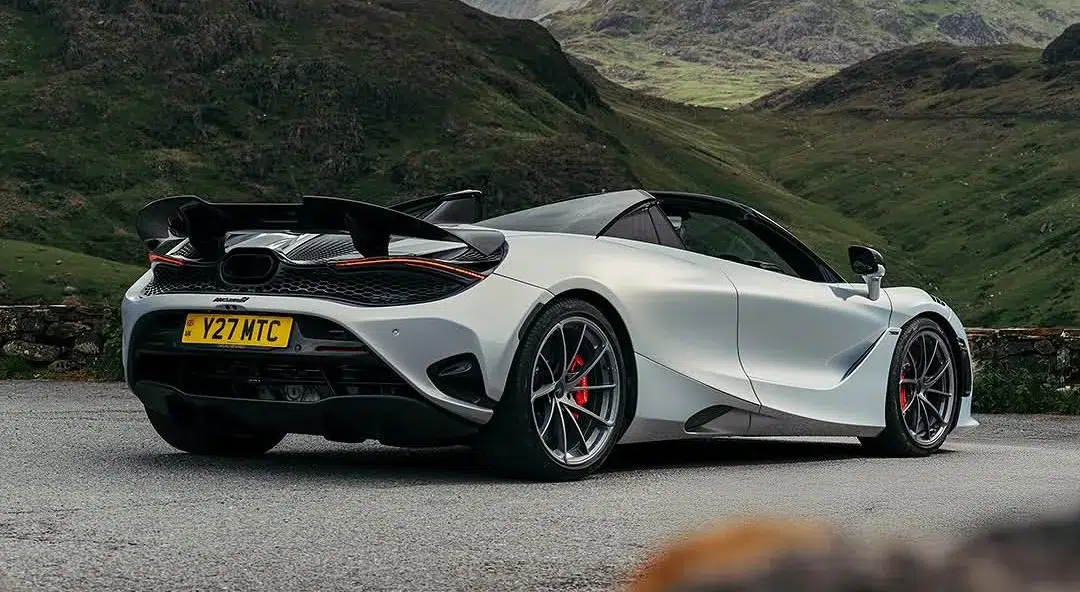
Following his recent purchase of the McLaren 750S Spider, Club GT Managing Partner Robert Crosthwaite Eyre shares his thoughts on what makes this particular supercar so compelling – and whether it represents a sweet spot in the modern supercar era.

In a world increasingly defined by hybrid powertrains, electronic intervention and ever more sophisticated technology – much of which can sometimes feel as though it is taking the driver further away from the experience – I think I may have found the sweet spot of the modern supercar.
The McLaren 750S Spider.
A genuine supercar with near-hypercar performance, but without losing the qualities that made us fall in love with these cars in the first place. A 4.0-litre twin-turbocharged V8 producing 750PS, driving the rear wheels. Hydraulic steering. Carbon-fibre construction. Relatively little weight. And, importantly, a sense of occasion every time you get behind the wheel. McLaren quotes a lightest dry weight of just 1,326kg for the Spider, despite its folding hard top.
Because I think we have reached a point where the purpose of a supercar is no longer simply about speed. How quickly does it accelerate in a straight line? How quickly can it lap the Nürburgring? How many electric motors does it need to remove another two-tenths from its acceleration figures? For the genuine enthusiast, does any of that really matter anymore?
Modern supercars have become so extraordinarily capable that outright performance is almost beside the point on the road. What matters now is the experience. The noise, the steering, the response, the sense of lightness beneath you. The connection between the driver, the engine and the rear wheels. The theatre of climbing into the car. And whether, once you’ve parked it, you find yourself wanting to get straight back in.
That is where I think some of the latest generation of hybrid supercars are beginning to lose something. There is no questioning their engineering brilliance or outright capability. But batteries, electric motors, four-wheel-drive systems and increasingly complex electronics inevitably bring additional weight and, in some cases, create a little more distance between the driver and what the car is doing beneath them.
In the pursuit of another level of performance that very few owners could ever exploit, are we sacrificing some of the sound, feel and theatre that made us want a supercar in the first place?
The market appears to be asking a similar question.
Over the last few years, and particularly more recently, serious enthusiasts and collectors have increasingly turned their attention towards some of the great non-hybrid cars: naturally aspirated V12s, great V8s and the final generations of cars with a distinctly analogue character. Ferrari 458 Speciales, 488 Pistas and F8s are obvious examples. The realisation seems to be dawning that the future may be technically faster, but it won’t necessarily be more engaging.
Which brings me back to the 750S.
Having recently ordered one myself, I genuinely think it could prove to be one of the best all-round car purchases I have ever made.Which is quite a statement considering I have owned a number of McLarens over the years, including the LT cars and a McLaren Senna.
Before driving the 750S, I had heard it described as something of a “765LT GT” – essentially taking much of the character and performance of the 765LT and putting it into a considerably more usable package. I initially thought that might be slightly optimistic.
Having now driven one, I don’t.
The 750S feels far closer to the 765LT than I anticipated. It has that same extraordinary immediacy, lightness and sense of connection, but without demanding the same compromises when you aren’t driving at ten-tenths. McLaren itself talks about the breadth of the car’s ability, from circuit driving to winding A-roads and long-distance use, and that may be the 750S’s greatest strength.
And then there is the sound. With the roof down, the V8 has a rawness and richness that genuinely surprised me. It had me smiling endlessly. In other recent cars – my Aston Martin Vantage being one example – I have previously turned to aftermarket exhaust systems to create that sort of theatre. The 750S delivers it straight from the factory.
Theatre matters just as much. Walk towards it and those extraordinary dihedral doors rise into the air. Look at the dramatic channels, scoops and vents carved into the bodywork. Then watch the active rear wing stand almost vertically under heavy braking, adding another theatrical streak to an already unmistakable silhouette.
This is what a supercar should look and feel like.
Yet beneath all that drama is a car of almost absurd capability. McLaren quotes 0–62mph in 2.8 seconds, 0–124mph in 7.3 seconds for the Spider and a top speed of 206mph. But those statistics are almost the least interesting thing about it.
What makes the 750S special is everything that happens between the numbers. You could take it onto a circuit and have a genuinely serious track-day car. You could spend a week crossing Europe on a Club GT tour and never feel as though you had brought the wrong machine. Or take it through the Cotswolds on a summer afternoon, roof down, before settling in for a weekend at one of the region’s great country house hotels.
Very few cars can genuinely do all of those things.

The Sweet Spot of the McLaren Market?
Then there is value. Take a look at what is happening elsewhere in the McLaren market and the 750S starts to make even more sense.
765LT Spiders are currently being advertised well into the £400,000s, with examples at around £470,000 and £499,000. The best Sennas have also moved back towards seven figures, with one low-mileage UK example advertised at £1.05 million after previously being offered below £1 million.
And now we have the new 788HS: the definitive and final evolution of the 720S/765LT/750S bloodline, limited to just 200 cars globally and split equally between Coupe and Spider. McLaren has yet to publish a UK list price, although it will sit substantially above the regular 750S and every car will pass through MSO. Against that backdrop, the 750S starts to look remarkably good value.
A highly specified new Spider can easily find itself around the £300,000-plus mark, but the used market now contains Spiders in roughly the £230,000–£295,000 range – potentially around £100,000 below the cost of a heavily specified new example.
And what exactly are you giving away?
Very little. You still have 750PS, rear-wheel drive, hydraulic steering, carbon-fibre construction, extraordinary acceleration and genuine track capability, all wrapped into one of the most usable supercars McLaren has produced. Yes, a 765LT is more focused, a Senna is more extreme and the 788HS will be considerably rarer and more exotic. But they now occupy very different financial territory.
Which is why the 750S increasingly looks like the sweet spot not just of the McLaren market, but perhaps of the current supercar market as a whole.
Could It Become Collectible?
I wouldn’t necessarily buy a 750S purely as an investment. It wasn’t launched as a numbered limited-production model, and history tells us that rarity alone doesn’t automatically make a car collectible.
But still, the numbers are interesting. Only 225 McLaren 750Ss have been registered for use on UK roads since the model arrived in 2023. For comparison, 375 Ferrari F8 Spiders have been registered here. Unfortunately, the DVLA classification doesn’t give us a reliable Coupe-versus-Spider breakdown for the McLaren, so we can’t say precisely how many 750S Spiders there are – but the total population itself is remarkably small.
Scarcity is only one part of the equation. The 750S is also one of the final expressions of this particular non-hybrid McLaren formula: a twin-turbo V8, rear-wheel drive, hydraulic steering and a lightweight carbon structure, without an electric motor or traction battery adding to the experience – or the weight.
That now looks particularly significant when McLaren itself describes the new 788HS as the final evolution of the lineage that began with the 720S. Perhaps that is why these cars increasingly feel like a moment in time.
Will the 750S become the next 458 Speciale? Probably not. But will we look back in ten years and wonder why cars this capable, this exciting and this scarce could be bought for around £250,000? I think there is every chance. Because the more I look at what is replacing cars like this, the more the 750S Spider feels like a sweet spot we may not see again.
It is faster than anyone realistically needs, light enough to feel alive, loud enough to make you smile, dramatic enough to stop people in their tracks, capable enough for a serious day on the circuit and comfortable enough to cross a continent. And when the sun comes out, the roof disappears in 11 seconds.
Perhaps that is what a modern supercar should actually be about. Not another Nürburgring record or electric motor or headline acceleration figure.
Just enjoyment.
And right now, I’m struggling to think of a supercar that does it better.
Imagery credits: @mclaren_za on Instagram


